We are delighted to announce that Seán and
Síle Murphy’s new book can now be purchased at the museum, price €20.00. The book contains additional material and
photographs from the image archive. We
only have a limited stock and copies are selling fast.
Dungarvan's Ironwork Heritage Part 15 - Ironwork Grave Surrounds
Many of the railings were made by major iron foundries
such as MacFarlane’s Saracen Foundry in Scotland. An example from this firm can be seen at St
Augustine’s cemetery, Abbeyside with the company logo attached. It surrounds the grave of the Curran family.
The railings in St Mary’s Parish Church and Saint
Mary’s Church of Ireland also contain much ironwork made by the Saracen
Foundry. These railings would have been painted originally which helps to
preserve them.
In St Mary’s Church of Ireland cemetery there are some
examples of early 19th century wrought iron railings.
For further information see:
Guidance for the Care, Conservation and Recording of
Historic Graveyards in
County Waterford, Waterford Co Council/Heritage Council 2011.
Iron – The repair of Wrought and Cast Ironwork. Government Publications, 2009.
![]() |
| Railing around Curran family grave St Augustine's Abbeyside, by Saracen Foundry, Glasgow |
![]() |
| Railing around Curran family grave, St Augustine's Abbeyside |
![]() |
| 19th century wrought iron railing St. Mary's Church of Ireland |

![]() |
| Grave railings St Mary's Parish Church |
![]() |
| Grave railings St Mary's Parish Church |
![]() |
| Perimeter railing St. Mary's Parish Church |
Dungarvan's Ironwork Heritage Part 14 - The Mission Cross St Marys Parish Church
This unusual
memorial can now be seen placed against the wall on the right as one enters the
cemetery. It consists of a large wooden
cross with the symbols of the Passion in ironwork. The crown of thorns, a heart, pinchers, lance,
nails etc., are all attached to the wooden cross. On the base of the cross is a plaque with a
painted inscription:
Mission of the
Oblate Fathers of Mary Immaculate A.D. 1860.
Edmond Keohan
in his History of Dungarvan gives the date of the cross as 1879. However, a historian of the order records the
Dungarvan mission which took place from 2 August to 9 September 1860. The following members of the order were
present: Fathers Robert Cooke, Fox, Gibbons, Nolan and Ryan. There were huge crowds and four recruits to
the order. There is also a reference to the erection of a cross, which is
presumably the present one. It is
possible that the wood was replaced in 1879.
Who were the
Oblate Fathers? The order was founded in
1816 by Eugene de Mazenod, later Bishop of Marseille. One of the members who participated in the
Dungarvan mission in 1860 was Father Robert Cooke (1821-1882). He was the author of a biography of de
Mazenod. Robert Francis Cooke was born
in Touraneena or Dungarvan on 14 February 1821. Family lore recalled that his grandmother was
the wife of a Mr. Cooke of Kiltinan Castle, Co. Tipperary. She converted to the Catholic faith and when
her husband died, she did not want to remain at Kiltinan as her sons would have
been brought up as Protestants. She
settled in Dungarvan working as a teacher.
Robert’s
father was a merchant in Dungarvan. In
the early 1840s Robert was sent to Dublin to study medicine and law. However, he wanted to pursue a different
path. In 1846 he was ordained in France
as a member of the Oblate order. He was
sent to England and eventually was appointed Superior of the order at Tower
Hill, London where he died on 16 June 1882 and was buried in St Mary’s cemetery,
Kensal Green. There is a memorial to him
in the Church of the English Martyrs, Tower Hill, London.
The Protestant
Policeman Beholds the Crucifix
Extract from
‘Echoes from the Decies’ by Tom Tobin
In the year
1863, a conversion, marked by the most extraordinary circumstances, took place
during a mission which the Oblates of Mary were conducting in Dungarvan. Philip John Mulligan, a young man from
Northern Ireland, a Protestant with a strong anti-Catholic bias, was a member
of the mounted Constabulary stationed in the town. One evening he was induced... by a friend to
attend the mission. He went as he
thought to enjoy a good scoff but instead the evening proved to be one he could
never forget. During the ceremonies a
penitential procession took place at which the Mission Crucifix was borne
around the church. The procession had
not got halfway through the church when the terrified cries and loud sobbing of
a man was heard by all present.
Philip
Mulligan’s own account of the occurrence is recorded:
As the
procession approached the spot where I stood, I noticed that several of those
who had not been able to kneel down, owing to pressure of the crowd, tried to
do so as the crucifix was passing near them.
When I beheld these marks of reverence being paid to the crucifix, my
Protestant prejudices were stirred up to anger, and I said to myself, that if
my Commanding Officer were to stand before me with drawn sword and order me to
kneel down before the crucifix, I would not obey him. I had scarcely formed such thoughts in my
mind when all of a sudden a ray of the most dazzling light, brighter far than
any sunbeam I had ever seen, flashed from the crucifix. In that light I saw all the sins of my life. Overwhelmed with a sense of sinfulness, I
fell prostrate on the ground... a few friends who stood by me could not account
for my emotion and thought I had taken a fit... at last I rose up... It was
then that the desire to become a Catholic rose irresistibly in my mind and I
repeated aloud to my astonished friends: Oh! what a happiness were I a
Catholic!
The Bishop of
Waterford was in Dungarvan and the missioners informed him of the remarkable
story. After a lengthy interview with
the young man, the Bishop decided that conditional baptism might be given him that
day, and he further said that he would be prepared to confirm him immediately
after. Two years later Mulligan became a
lay-brother in the Missionary Oblates of Mary Immaculate. He spent forty years on the foreign missions
in Basutoland, South Africa where he died in 1915.
![]() |
| The cross in its original location in 1966 |
![]() |
| Father Robert Cooke (1821-1882) |

Dungarvan's Ironwork Heritage Part 13 - Street Name Plaques
What’s in a Name?
- Street Name Plaques
The oldest street name plaques in Dungarvan can be
seen at Barrack Lane and Galwey’s Lane.
They are of carved limestone. The
first and oldest is inscribed ‘Castle Street 1727 B.G.M.’ and the other is
inscribed ‘Galwey’s Lane 1740’.
In the 1820s the Duke of Devonshire had new limestone
plaques erected on certain streets. Two
of these survive, one still in situ inscribed ‘New Chapel Lane’ and incorporated
into the gable end of a house in Mountain Villas. The other ‘St Patrick Street’ is now on
display in Waterford County Museum.
These stone plaques were expensive and time consuming
to produce and were replaced in 1885 by cast iron plaques made by Graham of
Waterford. We know approximately when
these plaques were erected as the details are recorded in the minute book of
the Dungarvan Town Commissioners dated 11 December 1885. Nineteen cast iron plaques were ordered from
Benjamin Graham of Waterford at a cost of six shillings and six pence each. In April of the following year John Donovan
was paid £1.7.6 for painting the lettering in white on a blue background. Almost
every street name was changed and renamed after Irish Nationalist figures.
One of these plaques caused much controversy. In November 1885 Maurice Flynn proposed that
Main Street be renamed Parnell Street. In
1889 the Commissioners proposed that plaster busts of Parnell and William
O’Brien M.P. be ordered for the council chamber. However, certain members of the Council
disapproved of Parnell’s relationship with a married woman, Katherine O’Shea,
whom he married after her divorce in June 1891. At their meeting on 3 July 1891 it was agreed
to remove the plaque on Main Street bearing Parnell’s name. Thomas Power proposed that the bust of Parnell
should be removed form the council chamber. Both were removed but the bust resurfaced in
1991 when it was presented to the museum by the then Town Clerk, Bertie White. On the anniversary of Parnell’s death in 1992
Dungarvan UDC erected new plaques, Parnell Street and Parnell Street Lower.
In the council minutes of 6
October 1900 is the following entry:
‘A deputation of the [Gaelic]League waited on the
Council requesting that the names of the principal streets should be marked by
a tablet giving the names of each street translated and written in the Gaelic
Characters’.
Only three can now be seen, Grattan Square, O’Connell
Street and Church Street. They are made
of much thinner metal than those erected in 1885.
First visitors to the Museum on reopening 1st July
Our first visitors to the museum on reopening on 1st
July were Declan and Joanne Faughey from Borris, Co. Carlow. Our curator William Fraher presented them
with a copy of “The Towns and Villages of the Waterford Greenway” to mark the
occasion. They were delighted to receive
the book since they had just cycled the greenway from Waterford.
Donation to the Museum
The museum was very grateful this week to receive a
donation by Jimmy Power of a black and white portrait of Dungarvan artist
Michael Mulcahy, along with a postcard by Edmund Keohan.
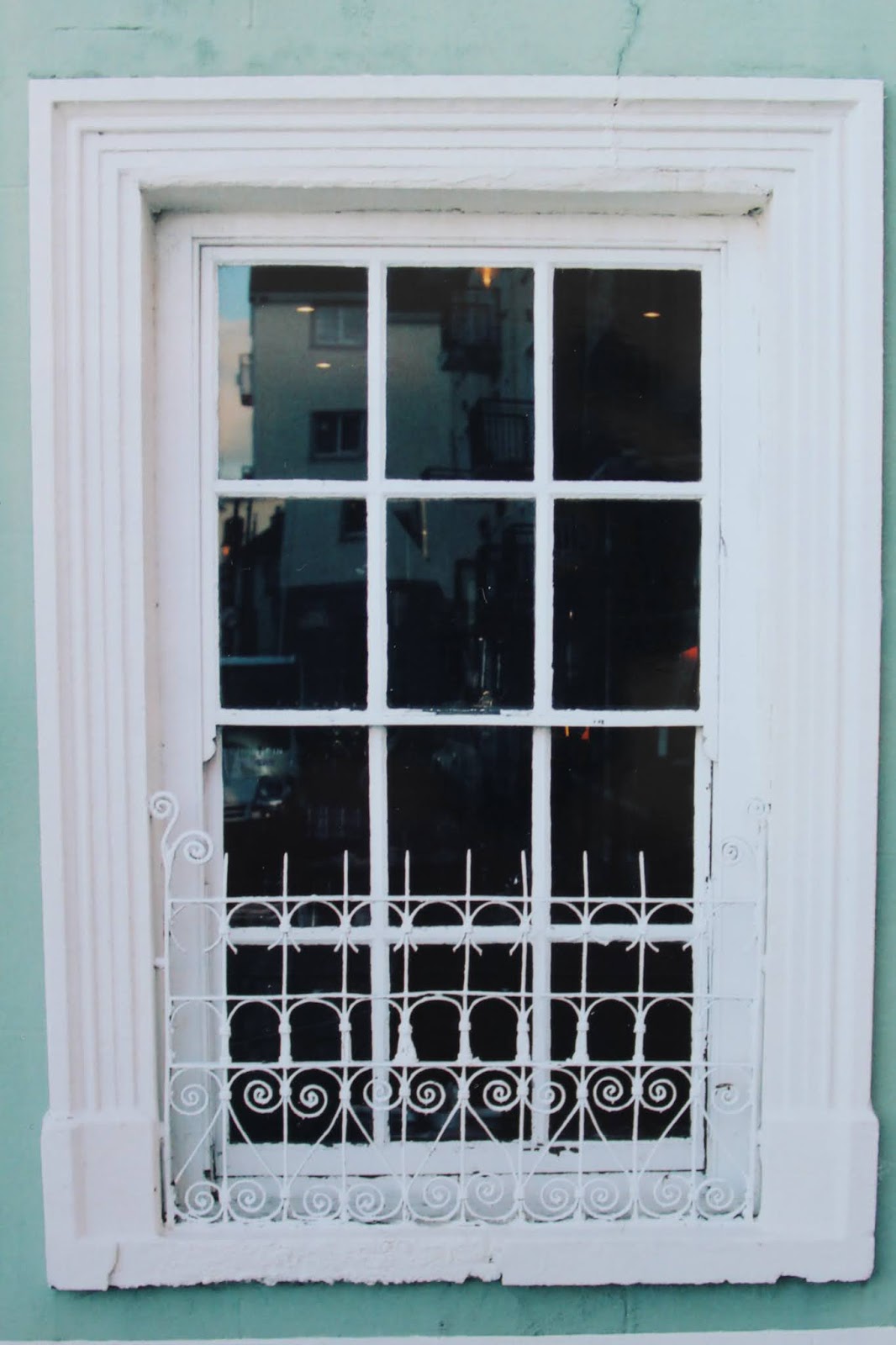
Dungarvan's Ironwork Heritage Part 12 - Window Guards
![]() |
| Window guard, Church St. |
![]() |
| Window guard, Main St. |
![]() |
| Window guard, Commercial Club, St. Mary's St. |
![]() |
| Window guard, Emmet St |
![]() |
| Window guard, The Moorings |
![]() |
| Window guard, Sexton St., Abbeyside |
![]() |
| Window guard, Augustinian school, Main st. |
![]() |
| Window guard Main St. design in MacFarlane's catalogue |
![]() |
| Bank House window guard |
![]() |
| Bank House window guard design from MacFarlane's catalogue |
![]() |
| Bank House window Guard with design from MacFarlane's catalogue above |
![]() |
| Drawing by W. Fraher |
Subscribe to:
Posts (Atom)